Design note 4 - what do we mean?
In addition to the similarities between our new icon and the real Northern Lights, we particularly liked some of the themes the Northern Lights icon represented, namely:


1.1 The aims of this policy and supplementary local protocols set out the expectations for all stakeholders in improving school attendance across our Trust to achieve our mission of ‘Creating remarkable schools where no child left behind’. We understand that securing good attendance is everybody’s business and in everyone’s interest.
1.2 As a Trust, we understand that the barriers to accessing education are wide and complex, both within and beyond the school gates, and are often specific to individual pupils and families. This policy sets out how all pupils will be supported to attend school regularly.
1.3 Beckfoot Trust recognises that good attendance begins with school being a place where pupils want to be. The foundation of securing good attendance is that each school is a calm, orderly, safe, and supportive environment where all pupils enjoy belonging, are ready to learn and are determined to succeed.
1.4 The law entitles every child of compulsory school age to an efficient, full-time education suitable to their age, aptitude, and any special educational need they may have. It is the legal responsibility of every parent or carer to make sure their child receives that education and ensure their child attends regularly at their registered school.
1.5 This policy and each school’s supplementary local attendance protocol will explain:
2.1 The purpose of this policy is to establish clear guidelines for improving attendance in our schools. It outlines our expectations for attendance and punctuality as well as clear procedures for all members of our school community: staff, pupils and parents or carers.
2.2 Legislation and Guidance
This policy is based on the Department for Education’s (DfE’s) statutory guidance on Working Together to Improve School Attendance and School Attendance Parental Responsibility Measures.
The guidance is based on the following pieces of legislation, which set out the legal powers and duties that govern school attendance:
It also refers to:
As a nationally focussed yet Bradford serving trust, we work closely with the Local Authority and apply all their local protocols, for example:
2.3 Links with other policies
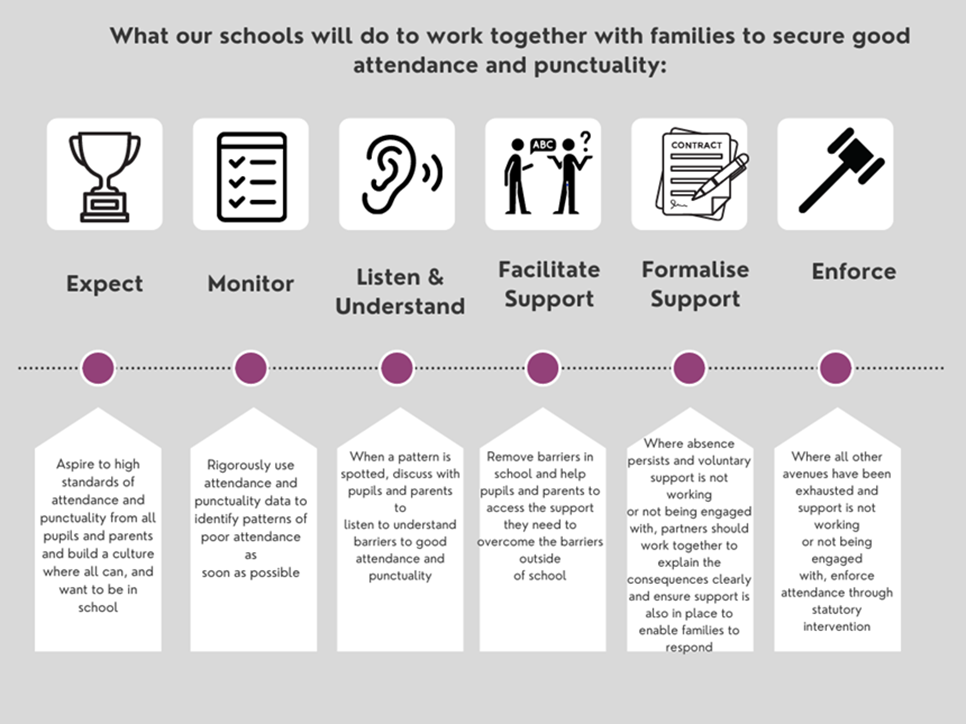
A summary of what Beckfoot Trust schools will do to ensure good attendance is summarised here:
The research tells us that there are three main benefits to good attendance:
Beckfoot Trust schools expect pupils to:
This diagram explains what Beckfoot Trust schools will do to support good attendance and punctuality.
The Trust Board is responsible for:
LSCs are responsible for:
Each school has their own attendance and punctuality local protocol with photographs of key staff in school to contact. In our Trust we have:
4.3.1 Executive Leaders
Hold accountability meetings every four weeks with headteachers regarding the effectiveness of their attendance strategies, providing support and challenge.
4.3.2 Central Team Attendance Lead
The lead for attendance across Beckfoot Trust will lead the strategic direction of attendance and punctuality across the Trust. They will quality assure the implementation of the attendance and punctuality policy and protocols in each school to ensure strategies are showing impact. They will provide guidance and support, signposting to external agencies where required.
4.3.3 Head of Data and Systems
The Head of Data and Systems will ensure that all schools have the systems and processes they require to be able to analyse their own school’s attendance and punctuality data in an efficient manner. They will endeavour that Beckfoot Trust schools are at the forefront in using technology such as Artificial Intelligence (AI) to support their individual attendance and punctuality improvement journey.
Attendance is everyone’s business. All members of school have a role to play in securing good attendance. Please see local attendance protocols for more detail for each individual school.
4.4.1 Headteacher
The Headteacher is responsible for:
Monitoring school-level absence data using all available tools (DfE, FFT, OEAI); acting upon the data and reporting to LSC and the Trust Board as required
4.4.2 A Senior Attendance Champion
Each school has appointed a Senior Attendance Champion who is a member of the school’s senior leadership team. The designated senior leader is responsible for:
4.4.3 SENCo and Designated Safeguarding Lead
The SENCo and DSLs are responsible for:
4.4.4 Attendance Officer and/or Administrators
The school attendance officer or school administrator are responsible for:
Monitoring and analysing attendance data, including updating trackers (such as SOL)
Providing regular attendance reports to school staff and report concerns about attendance to the designated senior leader responsible for attendance, and the headteacher in line with the attendance handbook
4.4.5 Class Teachers and/or Form Tutors and/or other Pastoral Staff
Class teachers/form tutors and other pastoral staff (see local protocols) are responsible for:
The attendance register is taken twice each day: one for the morning session and one for the afternoon session. Registers will close 30 minutes after they open. Any arrivals into a morning or afternoon session more than 30 minutes late will be marked as an unauthorised absence unless a suitable reason is provided (e.g. medical appointment). Please see each individual school’s protocol for what to do if a child is late to school.
All pupils are expected to attend school each day it is open unless the pupil is too ill to attend school, there is an unavoidable cause, it is a religious holiday for the pupil, or absences authorised in advance by the school.
Please refer to each school’s local protocol and/or school website for:
Registers will then be checked and cross referenced with any messages from parents or carers about absence. See Appendix 1 for a list of codes used for the registers and Appendix 2 for a list of Alternative Provision Codes for Bradford LA.
When a child is absent and no reason has been provided by the parent or carer, contact will be made by the attendance team to establish the whereabouts of the pupil. All available emergency contacts may be called. This is to ensure that the child is safe and to offer or signpost support if required.
Home visits may be carried out for safeguarding checks and/ or to offer support. Please see each school’s local protocol for individual school procedures.
External agencies such as Children’s Social Care, School Nurse Team, West Yorkshire Police and local schools where siblings or relatives are known to attend may be contacted if a child is absent and the reason for absence is unknown.
We encourage medical and dental appointments to be made outside of school hours wherever possible. If an appointment is required in school time, contact should be made to the school in advance and evidence of the appointment (e.g. letter or text) provided in order for the absence to be authorised.
Holidays in term time will not be authorised by headteachers in our schools and could lead to penalty notices being issued. Please see information below about penalty notices.
Our schools will recognise good attendance and celebrate with pupils and their families. Please see each school’s individual protocol for what this looks like in each school.
All our schools will use daily, weekly, half termly and annual attendance and punctuality data to analyse what is working well and what needs to improve. The data will be compared to local schools, similar schools, regional schools as well as all other national attendance data held by the Department for Education (DfE). This data will drive initiatives to improve attendance and punctuality in each school.
Data collected for individual pupils will enable schools to target support to help improve attendance and/or punctuality for individuals and groups.
Data will also be used to quality assure the work being done in schools to improve attendance to ensure they are focussing our attention on the right things. Attendance figures will be used, as well as feedback from families and children to inform school strategy.
Attendance and punctuality data will be shared with families through achievement reports. Families can also check their child’s current attendance via the apps that each school uses. If you believe there to be an error on your child’s record, please contact the school. (Please check each school’s local protocol for how to do this.)
If a pupil’s attendance drops to 90% or below, they are persistently absent. This is the equivalent to missing one day of school or more each fortnight over a school year.
If a pupil is absent more than they are present, they are severely absent. This is the equivalent to missing 50% or more of their school year. Beckfoot Trust schools will work with the local authority and other partners such as children’s social care to support the pupil to attend.
At Beckfoot Trust, we want to support pupils and their families in removing barriers to attendance. Each school’s local protocol for attendance and punctuality will outline their specific support available. However, you can see this intensification of support in the ‘staged approach’ diagram below:
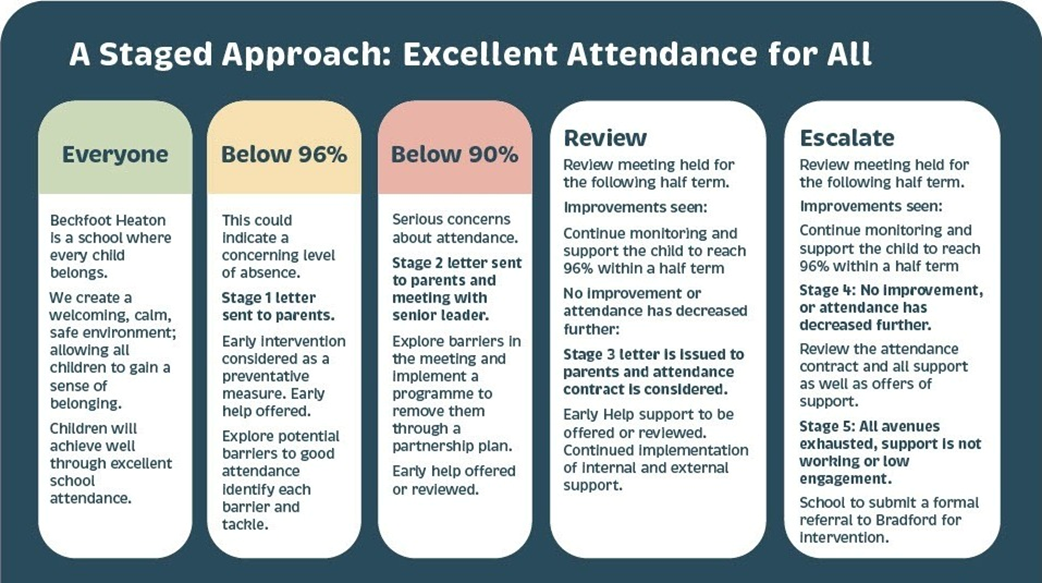
The school attendance team will meet with parents or carers of children where attendance falls below 90%. We believe that school and home should work together to improve a pupil’s attendance and punctuality. Therefore, Beckfoot Trust have ‘Partnership Plans’ where both school, home and the pupil will set out how they will jointly tackle barriers to attendance. An open and honest discussion will take place, barriers to attendance will be discussed and plan will be put in place with clear actions for everyone. The Partnership Plan will be checked regularly and then reviewed. Families will be given clear direction on who to contact if there is a problem.
Penalty notices may be sought if:
The local authority have advised that penalty notices can be issued to each parent liable for the attendance offence or offences. Penalty notices can be used where the pupil’s absence has not been authorised by the school. Penalty Notices are issued to an individual parent of an individual child. If the same individual parent receives a second penalty notice in relation to the same individual child within a 3-year period, they lose the ability to pay a discounted rate and must pay £160 within 28 days to avoid being prosecuted for the offence. Local Authorities can no longer issue a third penalty notice to the same individual parent for the same individual child within a 3-year period, parents will usually be prosecuted for the offence via the magistrates court.
Where all voluntary support has been exhausted, the Local Authority will work with the school and other agencies such as Children’s Social Care to enforce school attendance. This includes parenting orders, education supervision orders and prosecution through the courts.
When all avenues of support have been facilitated by schools, the local authority and other partners, but severe unauthorised absence continues, it is likely to constitute educational neglect. Schools will be conscious of safeguarding issues and where these remain, a full children’s social care assessment is recommended in line with Keeping Children Safe in Education.
At Beckfoot Trust we identify the needs of students by considering the needs of the whole child, not just the special educational needs or disability of the child. Consideration will be made for any young person who has or may have a disability or specific circumstances (see 3.3). Reasonable adjustments can be considered and implemented. The SEND Code of Practice outlines the “reasonable adjustment “duty for all settings and schools provided under current Disability Equality legislation. The following categories alone do not constitute SEND, but are tracked closely, and may trigger a monitoring period, if progress gaps are highlighted:
For pupils with complex health needs Beckfoot Trust has a Medical Needs policy which will be used to identify and remove any barriers to attendance.
For pupils with a social worker, schools will prioritise these students for first day calls and home visits alongside any pupils who are looked after or formally looked after. Children’s social care will be contacted by the Designated Safeguarding Lead on the first day of absence for any child on a child protection plan whose absence is unexplained.
This policy will be reviewed annually and, as guidance from the Local Authority or DfE is updated. The policy will be approved by the Trust Board.
Please download the PDF above to access the appendices.