Design note 4 - what do we mean?
In addition to the similarities between our new icon and the real Northern Lights, we particularly liked some of the themes the Northern Lights icon represented, namely:

In addition to the similarities between our new icon and the real Northern Lights, we particularly liked some of the themes the Northern Lights icon represented, namely:
To complement our dynamic new Northern Lights icon, we needed a strong colour pallette and confident, contemporary font.
The contrasting yet complimentary colours in our logo symbolises our value of diversity and unity. We often talk about 'the same but different' at Beckfoot Trust to acknowledge that whilst we have a very clear One Trust identity and clarity on what remarkable means, we also know that one size does not always fit all.

Perhaps the most important part of our new Beckfoot Trust logo is the icon, shown to the right here.
We call it our Northern Lights.
In nature, the Northern Lights are seen as something unique and truly Remarkable that are associated with the North.
Our Northern Lights icon represents The Beckfoot Trust which is also on a constant journey to Remarkable and is strongly associated with the North of England.

As part of our ongoing Journey to Remarkable we felt it was important to give The Beckfoot Trust a strong, confident and contemporary logo and brand that was worthy of an organisation with such high standards and aspirations.
The new Trust logo was a departure from the previous logo style and was definitely designed with the future in mind.

Effective risk management is a crucial tool in achieving the mission of the Trust to ‘create remarkable schools where no child is left behind.’ It is fundamental to every aspect of running our Trust and the schools within it and it is central to keeping children safe, improving attainment and all outcomes, working effectively with colleagues, ensuring financial sustainability, and managing the physical environment. Risk management takes place at all levels of the organisation and is inherent in all decision-making and in the day-to-day operation and the strategic management of our Trust.
The Trust Board are accountable for risk management and for ensuring that there is a sound system of internal control that supports the achievement of policies aims and objectives, whilst safeguarding public funds and assets for which it is responsible.
2.1 This policy sets out how Beckfoot Trust manages risk in a balanced and objective way to allow appropriate control as well as the flexibility to allow intelligent opportunity-taking to further the objectives of the Trust. This policy has due regard to other Trust policy and external guidance not limited to the following:
This policy explains how the Trust identifies, measures, manages, monitors, and reports risk. It explains the key roles and responsibilities in relation to risk and sets out how the Board ensures appropriate oversight of risk.
2.2 Linked documents
Risks are all potential events that are a threat to the safety of individuals and/or the achievement of our mission and objectives.
Risk management is defined by the Institute of Risk Management as “the process whereby organisations methodically address the risks attaching to their activities with the goal of achieving sustained benefit within each activity and across the portfolio of all activities.”
The key principles for our approach to risk across the Trust are:
The Trust will not take unnecessary risk unless justifiable. If taking a risk indicates that the reputation and/or operation of the Trust would be compromised, consideration of the likelihood and controls needed will be discussed with Trust Board.
4.1.1 Identify
Risk is considered with every plan and decision through executive and senior management meetings and in day to day discussion.
Consideration should be given to the categories of the risk below taking into account:
The Board will oversee the top risks identified for the Trust whilst the top identified school risks will be monitored locally through the Risk Register.
The Trust categorises risk as follows:
| Category | Definition |
| Governance | Risks related to the direction and control of the Trust |
| Educational | Risks related to the educational outcomes |
| Safeguarding | Risks related to the welfare and safety of pupils |
| Financial | Risks to the financial stability and sustainability of the Trust |
| Operational | Risks to the day to day running of the Trust |
| External | Risks external to the Trust that pose a threat |
| Compliance with law and regulation | Risks created by changing legislation or compliance issues |
| Strategic | Inherent risk in Trust wide decision making |
| Reputational | Risk to the reputation of the Trust |
4.1.2 Measure
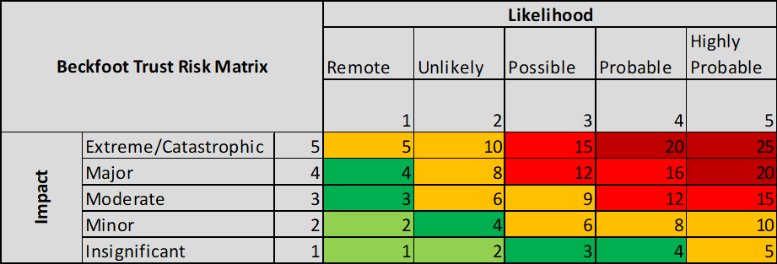
To understand each specific risk and allow for prioritisation, each risk is assessed according to its likelihood and the impact if it did occur. The descriptors of impact and likelihood are detailed in Appendix 1. Once impact and likelihood are determined, an overall risk score is calculated (Impact x Likelihood) in line with the table below. The control measures and further actions determine how actively the risk is reviewed.
4.1.3 Manage
Once the risk cause and effect are identified and understood, action is determined considering:
These are the actions which may be taken:
| Action | Explanation |
| Tolerate | No action taken Controls not deemed cost effective Risk impact so low it is considered acceptable |
| Treat | Control measures put in place to minimise likelihood of occurrence or of impact Potential identification of contingency measures in case of occurrence Demonstrable assurance identified in controlling the risk Risk re-assessed for residual risk score and rating |
| Transfer | Risk transferred to third party Usually via insurance or payment Risk re-assessed for residual risk score and rating |
| Terminate | Remove the risk Effective where there is no material effect on operations Considered when risk is highly ranked and other actions are impractical or too expensive Risk re-assessed for residual risk score and rating |
| Take Advantage | Considered when potential benefits of intelligent risk taking outweigh the potential negatives Intelligent risk taking may strategically advantage the Trust |
4.1.4 Monitoring
Monitoring of risks is ongoing and continuous and provides assurance on the extent to which the actions and controls are working as intended and whether risks are managed to an acceptable level. The Risk Register is the tool which allows effective monitoring, recording and reporting of risk.
The Executive Leadership Team and Headteachers are responsible for monitoring risk, and the risk owner is responsible for providing appropriate assurance that the risk is well-managed. Assurance may be provided in diverse ways depending on the level of the risk, the higher the risk the more likely it is that a higher level of assurance is needed.
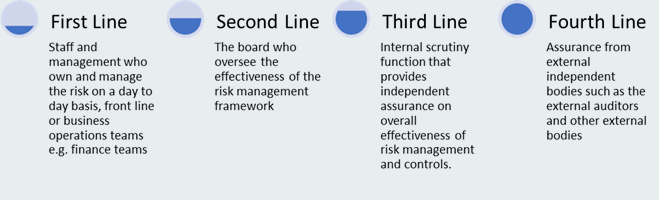
The four lines of assurance must be considered for any risk to provide a residual risk score with further controls / actions recorded to reach a target risk level.
A summary of each line of defence is below and should be used to explicitly evidence what is in place in relation to a risk on the risk register.
4.1.4 Reporting and Review
The Executive Leadership Team formally reviews the Trust risk register, each cycle prior to the Audit & Risk Committee or Board 1 meeting with consideration of school risks.
Headteachers formally review the school risk register termly with the senior leadership team and in relation to reporting to LSC. The risk register is also shared and considered in Executive Headteacher line-management meetings.
The school risk register may or may not inform the trust risk register and vice versa.
The Trust risk register is reviewed by the Audit and Risk Committee three times a year and is recommended for approval to the Trust Board as set out in the Scheme of Delegation. The review process is flexible and, in all cases, allows for targeted focus on the highest priority risks
4.2.1 Trust Board
4.2.2 Audit and Risk Committee
4.2.3 CEO/Accounting Officer
4.2.4 DCEO/Deputy Chief Executive Officer
4.2.5 Executive Leadership Team
4.2.6 Headteachers
4.2.7 Person Accountable for Named Risk
4.2.8 Risk and Compliance Manager
4.2.9 Trust Operations Support Manager
This policy is reviewed annually.
Please download the PDF above to access the appendices.